
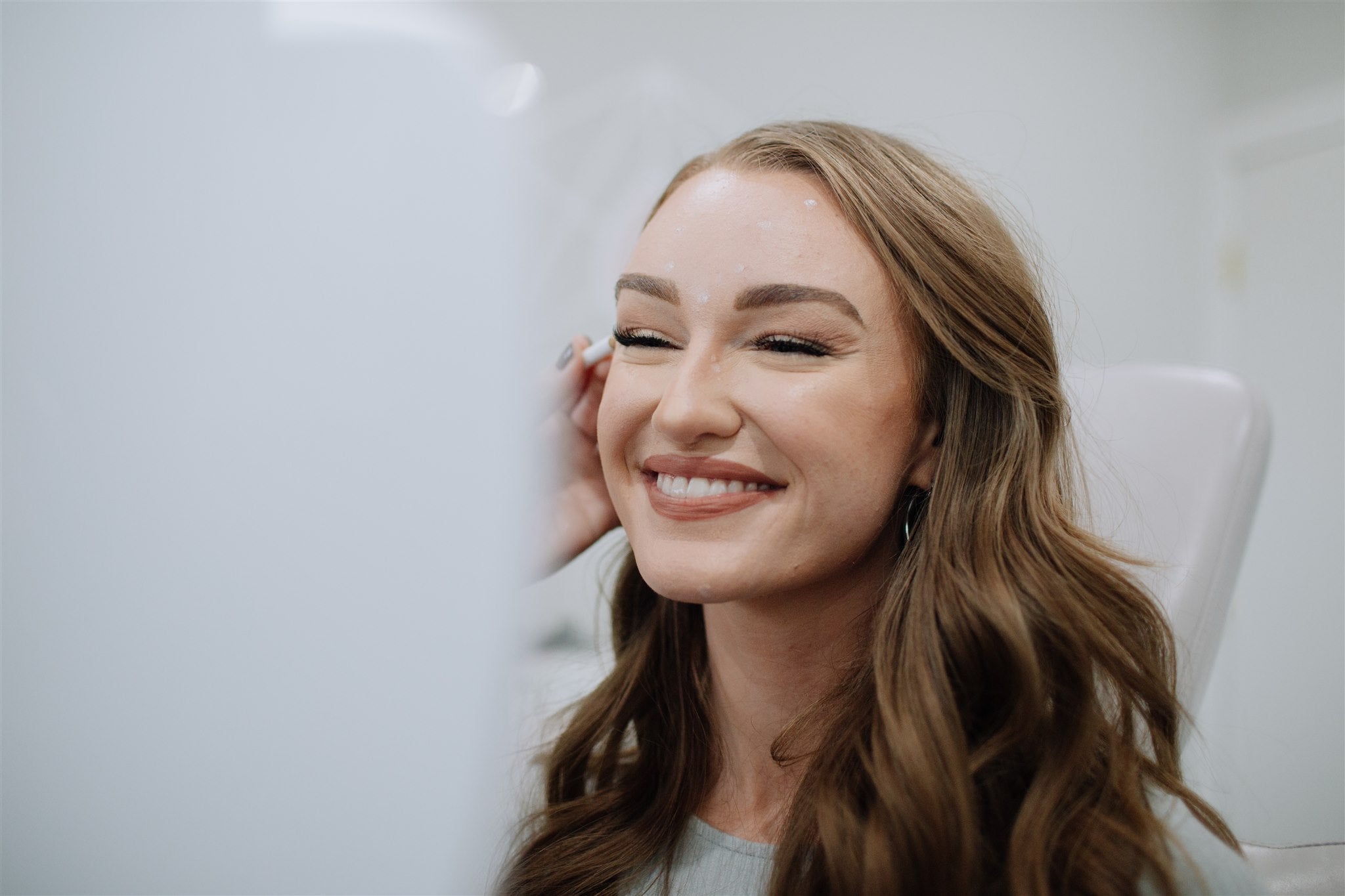

You noticed it sometime in late August. Maybe it was the bathroom mirror in the morning light, or a photo from the lake that someone tagged you in. Your face is blotchier than it was in May. There's a patch across your cheekbone that wasn't there before, or a scatter of brown spots along your temple that used to be one or two and are now a dozen.
You've probably already tried something. A brightening serum from the drugstore, faithfully, for three or four months. And it did almost nothing.
Here's the part nobody told you: that serum most likely failed because it was aimed at the wrong kind of pigment. Not because you used it wrong, and not because your skin is a lost cause. Dark spots come in a few distinct varieties, and they respond to completely different treatments. This article explains which kind you're looking at — and what actually clears it.
What hyperpigmentation actually is
So what is hyperpigmentation? It's the clinical word for any area of skin that has turned darker than the skin around it. The cause is always the same substance: melanin — the pigment that gives skin its color.
Melanin is made by cells called melanocytes, which sit at the base of your outer skin layer. Think of them as tiny factories on a dimmer switch. Ultraviolet light, inflammation, heat, and certain hormones all turn that dimmer up. When those factories overproduce in one area, or when pigment gets deposited deeper than it should, you get a spot, a patch, or a general muddiness of tone.
Ultraviolet exposure is the number one driver, by a wide margin. That's why hyperpigmentation shows up on the face, chest, shoulders, and backs of the hands — the places that have absorbed decades of North Idaho summers. It's also why late summer is when most people finally notice it. Pigment that built up quietly over June and July becomes obvious in September, once the surrounding tan starts to fade and the contrast sharpens.
The good news is that hyperpigmentation is one of the most treatable concerns in aesthetic medicine — as long as the treatment matches the type.
The three kinds of dark spots — and why it matters
Almost everything people call "sun spots" or "age spots" falls into one of three categories. Telling them apart is the single most important step in getting rid of them, because the treatment that clears one beautifully can make another one worse.
Melasma shows up as larger, symmetrical patches with soft, blurry edges, usually brown or grayish-brown. It favors the cheeks, forehead, upper lip, and bridge of the nose, and it tends to appear on both sides of the face in a mirror-image pattern. Melasma is driven by hormones as much as by sun — pregnancy, birth control, and hormone therapy are common triggers — and it is worsened by both UV light and heat.
Sun spots — clinically called solar lentigines — are the small, discrete, sharply defined tan-to-brown spots that accumulate on sun-exposed skin. They have crisp borders, they don't come in symmetrical pairs, and they show up exactly where you've had the most exposure: temples, cheekbones, chest, forearms, hands.
Post-inflammatory hyperpigmentation (PIH) is the flat brown or reddish mark left behind after the skin has been injured or inflamed — a breakout, a bug bite, a patch of eczema, a scratch. It sits exactly where the original problem was. PIH is most common and most persistent in medium-to-deep skin tones.
| Melasma | Sun spots (solar lentigines) | Post-inflammatory hyperpigmentation | |
|---|---|---|---|
| Shape and edges | Large patches, soft blurry edges | Small, discrete, sharply defined | Flat marks matching the original injury |
| Pattern | Symmetrical, both sides of the face | Scattered, asymmetrical | Wherever the inflammation was |
| Typical location | Cheeks, forehead, upper lip, nose | Temples, cheekbones, chest, hands | Face, back, chest — anywhere |
| Main driver | Hormones plus UV and heat | Cumulative sun exposure | Acne, eczema, injury, irritation |
| Responds best to | Topicals, gentle peels, microneedling, RF microneedling, strict sun protection | IPL photofacial, BBL, Moxi, laser, peels | Treating the cause first, then the pigment |
| Light-based treatment | Generally avoided — can worsen it | Excellent option | Case by case, with caution |
That last row is the whole game. Matching the treatment to the type of pigment is the difference between clearing your skin and setting it back six months. It's also the first thing we sort out at a consultation, before anyone turns on a device.
BBL laser for sun spots and sun damage
If what you have is true sun damage — those discrete brown spots on the temples, cheekbones, chest, and hands — BBL is the most reliably satisfying treatments in aesthetics.
BBL stands for BroadBand Light. Instead of one wavelength, a BBL delivers a broad spectrum of light that the darker pigment in a spot absorbs more readily than the surrounding skin. That absorbed light becomes heat, the pigment breaks up, and your body clears it. Because the light also targets the red of dilated blood vessels, the same session that fades brown spots often calms facial redness and broken capillaries.
Most people describe an BBL treatment as a a warm sensation combined with a quick, mild snap against the skin—frequently compared to a light rubber band snapping. A full face treatment usually takes well under an hour.
The response afterward is worth knowing about in advance, because it surprises people who weren't warned. Your spots get darker before they disappear. Over the first day or two, treated pigment lifts toward the surface and turns into little coffee-ground flecks. Over roughly the next week, those flecks flake away on their own. Most people go straight back to normal activity — makeup, work, the gym — with only that speckling to manage.
How many sessions? A 2025 systematic review of clinical trials for solar lentigines found success rates for BBL in the range of 75% to 90%, with results improving over a series of treatments rather than all at once. Most patients see meaningful clearing within a short series, though how many depends on how much accumulated sun damage there is. Your clinician will map out a realistic number after looking at your skin — we won't promise you a session count before we've seen it.
[IMAGE GALLERY: BBL laser before-and-after results, captioned with the number of sessions for each patient]
If you're not sure whether what you have is sun damage or something else, that's exactly what a consultation is for. Book a consultation and we'll tell you honestly which category your pigment falls into before you spend a dollar on treatment.
What about melasma?

We generally do not recommend BBL or other broad-spectrum light treatments for melasma. Melasma's pigment cells are already overactive and unusually sensitive to light and heat, and broad-spectrum light delivers plenty of both — the heat diffuses into surrounding tissue rather than staying on target. Mayo Clinic clinicians note that with BBL, melasma often returns quickly, and the heating of surrounding skin is thought to worsen it. Short-term improvement followed by a rebound within a few months is a well-documented pattern.
None of that means melasma is untreatable. It means melasma is managed with a different set of tools — all of which we offer:
- Medical-grade topicals. The daily foundation. Ingredients such as niacinamide, vitamin C, azelaic acid, and retinoids work on pigment production over weeks and months. We carry SkinBetter Science Hydrinity, and SkinCeuticals, including tone-correcting serums formulated for exactly this.
- Gentle chemical peels. Depth is adjustable, which matters enormously here. A superficial, melasma-appropriate peel lifts surface pigment without generating the inflammation that makes melasma flare.
- Microneedling and RF microneedling. Radiofrequency energy delivered through microneedles, without broad-spectrum light hitting the pigment directly. It's a useful option when you want to address texture and tone together.
- Prescription options through a clinician. Tri-Luma, which contains hydroquinone, is the only FDA-approved hydroquinone product and is prescription-only in the United States, indicated for short-term use in moderate-to-severe facial melasma. Unapproved over-the-counter hydroquinone products have been off the US market since September 2020. Tranexamic acid, taken orally or applied topically, is well studied for melasma but is not FDA-approved for that use; it's prescribed off-label. These are decisions for a prescriber who knows your history.
- Photoprotection. Not optional, and not a footnote. Sun and heat protection is what holds every other result in place.
If you are pregnant or breastfeeding, tell us at your consultation. Melasma is frequently hormonal, it often appears during pregnancy, and several of the treatments above are not appropriate during pregnancy or nursing. That's a conversation to have before we build a plan, not after.
Post-acne marks and PIH
If your dark spots sit exactly where breakouts used to be, you're most likely dealing with post-inflammatory hyperpigmentation. These marks are flat — they're a color problem, not a texture problem, which distinguishes them from true acne scarring.
The sequence here matters. Treat the cause first, then the pigment. Clearing PIH while the skin is still actively breaking out is a treadmill: every new lesion leaves a new mark. Get the inflammation under control, and a good share of existing PIH will fade on its own over several months. What remains responds well to targeted topicals and appropriately gentle resurfacing.
If active breakouts are the underlying issue, start there — our acne treatment options and Face Reality Products are the right first step, and the pigment work follows.
Matching treatment to pigment type
| Treatment | Sun spots / sun damage | Melasma | Post-inflammatory hyperpigmentation |
|---|---|---|---|
| BBL laser | First choice | Generally avoided | Case by case, with caution |
| Chemical peels | Yes | Yes, at gentle depth | Yes, once the cause is controlled |
| RF microneedling | Yes, for tone plus texture | Yes — a light-free option | Yes |
| Medical-grade topicals | Yes, as maintenance | Yes — the foundation | Yes |
| Prescription options | Rarely needed | Yes, prescriber-directed | Sometimes |
| Broad-spectrum SPF 30+ | Always | Always | Always |
Your skin type changes the plan

Clinicians classify skin on the Fitzpatrick scale, a six-point range describing how much pigment your skin has and how it responds to sun. Types I and II burn easily and rarely tan. Type III burns sometimes and tans gradually. Types IV, V, and VI tan readily and burn rarely, with progressively deeper natural pigmentation.
This isn't trivia. BBL is best suited to Fitzpatrick types I through III. In deeper skin tones, the higher melanin content in the outer skin layer absorbs a much larger share of the light energy — so instead of the light finding only the spot you're treating, the surrounding skin competes for it. That raises the risk of burns, post-inflammatory hyperpigmentation, and hypopigmentation, where treated areas end up lighter than the skin around them.
For deeper skin tones, that's a reason to change the plan, not to give up on it. We route type IV through VI patients toward approaches that don't depend on broad-spectrum light: medical-grade topicals, carefully chosen peel depths, RF microneedling, and prescription options through a clinician. Recent tanning matters too: a fresh tan temporarily behaves like a darker skin type, which is one reason fall and winter are the right season for light-based treatment.
Assessing your skin type before recommending a device is standard practice here — and it's the step most likely to be skipped where the person holding the device isn't a licensed clinician.
What the research says
Pigment treatment has better evidence behind it than most people assume.
In 2026, a panel of ten pigmentary-disorder specialists from Africa, Asia, Europe, and the Americas published a global consensus on the management of melanin hyperpigmentation disorders in the Journal of the European Academy of Dermatology and Venereology. Two of its conclusions are directly relevant here. First, treatment should be stratified by disease subtype and by how deep the pigment sits — which is the clinical version of everything this article has said about matching treatment to type. Second, effective management has to address more than the pigment cells themselves; the surrounding skin environment, including blood vessels and inflammatory cells, is part of the picture.
On specific treatments: the systematic review of solar lentigine trials cited earlier puts BBL among the more effective options for true sun damage. For melasma, the American Academy of Dermatology describes hydroquinone, tretinoin with a mild corticosteroid, triple-combination cream, azelaic acid, kojic acid, vitamin C, and tranexamic acid for resistant cases — and emphasizes daily broad-spectrum SPF 30+ with zinc oxide, titanium dioxide, or iron oxide as the foundation for all of it.
What the research does not support is a single treatment that fixes everything. That's why the assessment comes first.
What to expect at Renew Aesthetics & IV Hydration Bar
Your first visit is a conversation, not a procedure.
 We start by looking at your skin in good light and identifying what kind of pigment we're actually dealing with — melasma, sun damage, post-inflammatory marks, or, quite often, a combination. We assess your Fitzpatrick type and ask about recent sun exposure and tanning. We take a history: pregnancy or breastfeeding, hormone therapy or birth control, any photosensitizing medications, recent isotretinoin use, and any history of unusual scarring.
If you have a pigmented spot that is new, changing, growing, irregular in shape, or uneven in color, tell us. That needs to be evaluated to rule out skin cancer before any cosmetic treatment — no exceptions, and no cosmetic device goes anywhere near it until it's been cleared.
From there we build a plan: which treatments, in what order, over what timeline, and what you'll do at home between visits. Then we treat, and we follow up.
Every treatment at Renew is performed by a licensed RN or NP. Our nursing team are national trainers for five leading aesthetics companies — which is the honest reason to trust us with a light-based device on your face. Getting IPL right is far more about assessment and judgment than about owning the machine.
Prevention: the part nobody wants to hear
Pigment management is ongoing. UV exposure is the primary driver of nearly every kind of hyperpigmentation, so sun protection isn't the boring afterthought to your treatment plan — it's what preserves the result you paid for.
Daily broad-spectrum SPF 30 or higher, every day, including North Idaho winters and cloudy mornings. Reapply every two hours when you're outside. Mineral filters — zinc oxide and titanium dioxide — are the better choice for pigment-prone skin, and tinted mineral sunscreens containing iron oxide add protection against visible light, which also drives melasma.
If you have melasma specifically, heat matters as well as light. Hot yoga, saunas, long stretches over a hot stove, and even a very hot shower can trigger a flare. It isn't about avoiding your life — it's about knowing what sets your skin off. Ask us which medical-grade sunscreen and corrective skincare fits your routine; we'll match it to your skin rather than selling you the whole shelf.
Cost and sessions
Pigment treatment is usually priced by treatment area or by the size and number of spots addressed, and most plans involve a short series rather than a single visit. Topicals and sun protection are an ongoing cost layered on top of that, and they're the least expensive and most important part.
Around the Coeur d'Alene and Spokane market, a full-face BBL laser at a medical practice typically runs in the mid-hundreds per session, with package pricing common for a series. Cosmetic treatment of hyperpigmentation is not covered by insurance, since it's considered cosmetic rather than medically necessary. We'll give you exact pricing for your specific plan at your consultation, before you commit to anything.
Frequently asked questions
How do I know if I have melasma or sun spots?
Melasma tends to show up as larger, symmetrical, soft-edged patches on the cheeks, forehead, or upper lip, and it often follows hormonal changes such as pregnancy or starting birth control. Sun spots are smaller, more sharply defined, and appear where you've had the most sun. The distinction matters because they respond to different treatments — and it's the first thing we sort out at a consultation.
Can BBL treat melasma?
Generally we don't recommend it. The heat and broad-spectrum light can stimulate already-sensitive pigment cells and make melasma darker, and improvement often relapses within a few months. For melasma we use a gentler combination of medical-grade topicals, appropriately shallow peels, RF microneedling, prescription options through a clinician, and strict photoprotection.
How many BBL sessions will I need for sun spots?
Most patients see meaningful improvement within a small series of sessions, though it depends on how much accumulated sun damage there is and where it's located. Your clinician will map out a realistic number at your consultation — we'd rather give you an honest estimate after seeing your skin than a number over the phone.
Will the spots come back?
Pigment management is ongoing. UV exposure is the main driver, so daily sun protection is what preserves your result. New sun damage can accumulate over time, and melasma in particular is prone to flaring, so most patients maintain with periodic treatment and a consistent home routine.
Does it hurt, and is there downtime?
Most patients describe BBL as a quick snap of heat, like a rubber band, with cooling in between. Treated spots typically darken into small flecks first, then flake away over about a week. Most people return to normal activity right away, with makeup if they want it.
Why didn't my drugstore brightening serum work?
Usually because it was aimed at the wrong kind of pigment, or it wasn't formulated to reach the depth where your pigment actually sits. That's not a personal failure — it's a matching problem, and matching problems are fixable once you know what you're treating.
The bottom line
Uneven skin tone after a long summer is one of the most solvable things we see. Sun spots respond beautifully to BBL laser. Melasma is manageable with a gentler, layered plan. Post-acne marks fade once the underlying breakouts are handled. The only real mistake is guessing — because the treatment that clears sun damage can set melasma back.
The most useful first step is simply finding out what kind of pigment you're dealing with, because that answer determines everything else. If you'd like a licensed clinician to take a look and tell you honestly what would work on your skin, book a consultation or call us at (208) 930-6823. Fall is the right season to start: light-based treatments work best when you're out of the summer sun.
This article is for educational purposes only and is not a substitute for medical advice, diagnosis, or treatment. Some treatments discussed may involve off-label or prescriber-directed use; off-label use is legal and common in medicine but means the FDA has not specifically approved the product for the use described. Individual results vary. Any new, changing, or irregular pigmented spot should be evaluated by a qualified clinician. Speak with a licensed clinician about your individual health history before starting any treatment. Last medically reviewed: Angela, RN | 23+ years clinical experience | National Trainer, Aesthetic Medicine · Last reviewed: September 2026